Applications and venues

RCF Industries served by professional audio systems

Every venue type asks a different question of a loudspeaker system. Touring teams need repeatability, installed rooms need coverage that respects architecture, corporate spaces need speech clarity, and hospitality environments need sound that supports the room without taking over the design.

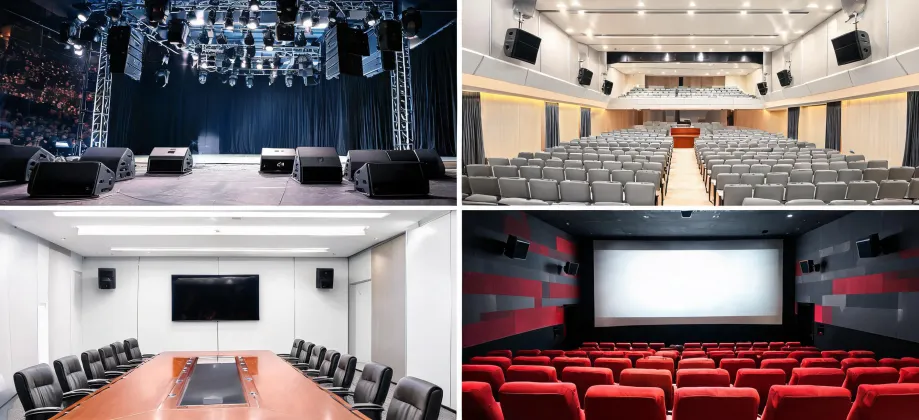
Four professional audio venue applications
Built around use

Match system behavior to the way people use the space

Live sound and touring

Touring packages need clear deployment routines. RCF planning for this environment focuses on scalable PA speakers, line array elements, subwoofer groups, monitor wedges, fast cable layouts, and packaging that can be repeated by different crews across different stops.

  • Fast load-in rhythm
  • Repeatable coverage notes
  • Durable stage workflow

Installed venues and worship

Permanent rooms need a system that respects sightlines, architecture, service access, and volunteer operation. Loudspeaker placement, fill decisions, and low-frequency control are discussed alongside building limits instead of being treated as separate technical islands.

  • Speech intelligibility
  • Discreet rigging choices
  • Long-term service access

Corporate and education

Conference halls, lecture rooms, and training spaces place a premium on speech clarity and predictable controls. RCF system conversations consider presenter movement, hybrid meeting use, room reconfiguration, and the staff members who must operate the system every week.

  • Clear voice coverage
  • Simple operating notes
  • Flexible room layouts

Cinema, hospitality, and retail

Public spaces need audio that feels intentional without overwhelming the environment. Loudspeakers, subwoofers, and distributed reinforcement are selected with attention to visual design, guest comfort, local zoning, and the content mix expected during daily operation.

  • Balanced room energy
  • Architectural integration
  • Program-specific tuning
Find your family

Questions that point to the right system family

This guide is written for buyers comparing loudspeakers, PA speakers, line array systems, subwoofers, and stage monitors. A productive short list starts with the venue behavior, not with a favorite model number. The answers below help separate portable reinforcement, permanent installation, and hybrid packages that must move between both worlds.

Selection considerations

Technical trade-offs behind an RCF venue choice

There is rarely one correct loudspeaker for a room. The honest decisions sit between competing priorities, and RCF planning surfaces them early instead of letting them appear at commissioning.

Powered vs passive systems

Active RCF boxes integrate amplification and DSP inside the cabinet, which shortens setup, keeps gain structure consistent, and suits portable PA workflows. Passive systems hand control to external amplifiers and processing, which some integrators prefer for centralized racks and long fixed installs. The trade is convenience and tuned matching against rack flexibility and serviceability.

Line array vs point-source

Line arrays project even coverage down a deep audience plane and pay for it in rigging, trim height, and box count. A point-source cabinet is faster to deploy and lighter on structure, but its useful throw runs out in long halls. The deciding factors are audience depth, available flying points, and how often the room changes shape.

In-house transducers vs sourced drivers

RCF is positioned around transducers engineered and built in-house, which keeps the woofer, compression driver, and cabinet tuned as one design rather than assembled from third-party parts. The benefit is predictable behavior across a product family; the counterweight is that buyers comparing on raw component spec sheets must weigh integrated voicing against mix-and-match component shopping.

Integrated DSP vs external processing

On-board presets get a system close to flat quickly and reduce operator error in venues with rotating staff. A dedicated external processor offers deeper control for engineers who want to shape every band, at the cost of more configuration to document and maintain. Operator skill and handoff frequency usually settle this choice.

Honest limits

Where a loudspeaker system reaches its boundaries

A reliable recommendation names what a system will not do as clearly as what it will. These are the constraints RCF planning keeps on the table.

SPL and coverage ceiling

Every cabinet has a rated maximum output and a coverage angle. Pushing a compact box to fill an oversized room past its pattern produces distortion at the edges, not more reach. Beyond a point only more boxes or a different array geometry will extend usable level.

Power compression and thermal limits

Sustained high-level music heats the voice coils, and as they heat, sensitivity drops and the system needs more drive to hold the same level. Long programs at the ceiling of a system behave differently from a short specification test, so headroom is planned rather than assumed.

Environment and weather exposure

Humidity, outdoor temperature swings, dust, and reflective or absorptive surfaces change real-world results. Indoor-rated enclosures are not a substitute for weather protection, and a room that measures well empty can behave differently once it is full of people.

Maintenance and operator dependence

Presets, firmware, networked control, and rigging hardware all need upkeep. A system that is only understood by the commissioning crew becomes fragile once they leave, which is why documentation and operator training are treated as part of the deliverable.

Application review

Describe the venue, not only the equipment

Send the audience plan, event types, operator profile, and the sound problems you want solved. RCF support can help translate those notes into a practical loudspeaker direction.